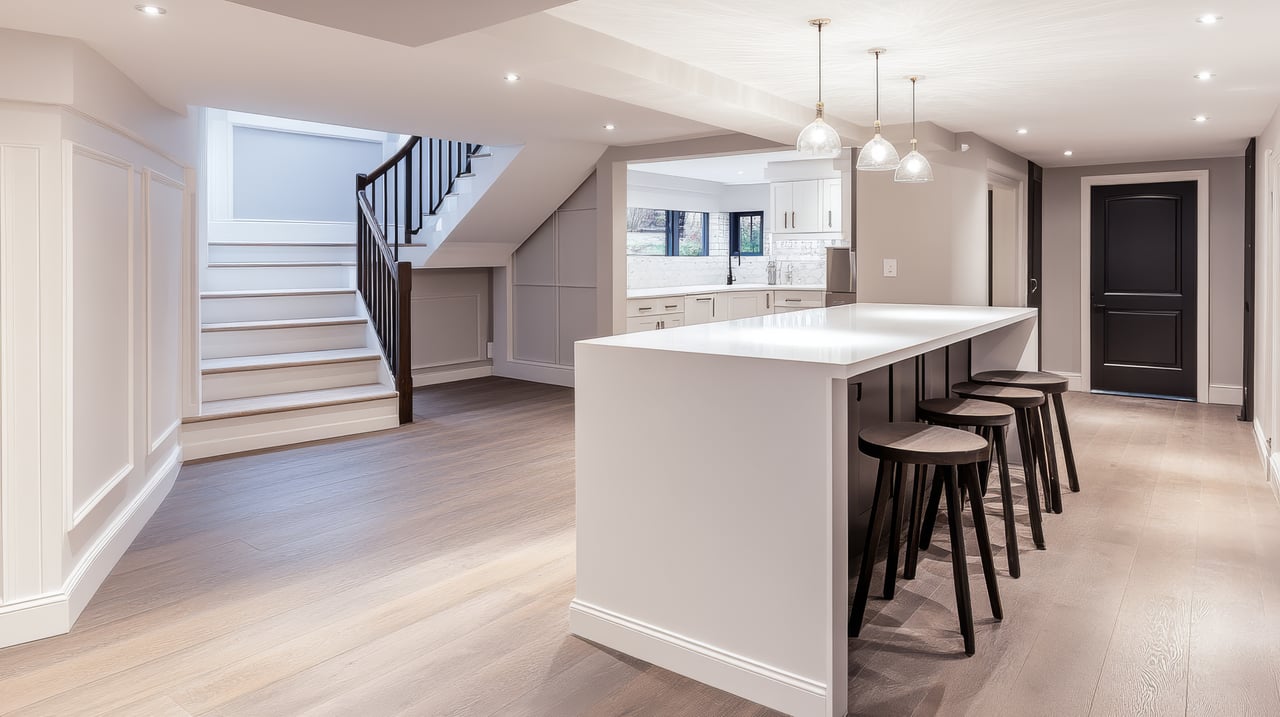
There is a particular kind of confidence that comes with a beautifully finished basement. The wet bar, the home theater, the extra bedroom with its own bathroom — all of it has a way of making homeowners feel like they have essentially added another floor to the house. And to be fair, some of these spaces genuinely feel that way. The problem is that the market does not always agree.
In real estate, square footage is not a single, uniform commodity. Where that square footage is located matters enormously to how it is valued, and finished basements occupy a distinct category all their own. Understanding that distinction is not just an exercise in technical trivia. It has real implications for how homes are priced, how buyers evaluate what they are getting, and how much return a homeowner can realistically expect from a renovation investment.
Above Grade and Below Grade: The Line That Matters
The foundational concept here is the division between above-grade and below-grade living space. Above-grade space is the portion of a home that sits at or above ground level. Below-grade space is anything below it, including finished basements, regardless of how sophisticated the finish might be.
This is not an arbitrary distinction. Basements, by their nature, present different conditions than main-level living space. Natural light is limited or absent. Egress considerations are more complex. The potential for moisture is higher. Even in a beautifully finished space, these underlying characteristics influence how the market perceives and prices that square footage.
Appraisers account for this by valuing above-grade and below-grade space separately. A finished basement contributes to the overall value of a home, but it does so at a lower per-square-foot rate than the living space above it. That gap is consistent, even when the finishes in a basement rival or exceed those found upstairs.
What Actually Moves the Needle
Within the category of finished basement space, certain features carry more weight than others. A bathroom below grade generally adds more meaningful value than open finished space alone. A bedroom with proper egress improves both usability and appeal, which in turn has a positive effect on value. A recreation room or open flexible space, while certainly attractive to buyers, tends to contribute the least on a per-square-foot basis without those additional functional elements.
This is not a knock on any of those features. It is a reflection of how buyers actually use and prioritize space, and appraisers work from that same framework.
Walk-Outs, Ceiling Heights, and the Grade Question
Walk-out basements occupy a more favorable position in the valuation conversation. Because they introduce natural light and exterior access, they feel and function more like main-level space, and the market tends to reflect that with higher values relative to standard below-grade configurations. Taller ceiling heights can have a similar effect, softening the psychological distance between the basement and the rest of the house.
What these features do not do, in most cases, is change how the space is classified. Classification is based on grade, not on how the space feels from the inside. If any portion of a level sits below ground, it is generally treated as below grade for valuation purposes.
This is where hillside homes present a specific complication. A lower level that is fully exposed from the rear of the home and grades to the ground from the front is a common configuration in St. Louis. That space may live and feel like a main floor. It may have tall windows, direct exterior access, and abundant natural light. But if the grade at the front of the home places it below ground, it is typically still classified as below grade. There are exceptions, and comparable sales can influence how an appraiser approaches it, but the general principle holds.
Where Homeowner Expectations and Market Reality Diverge
The gap between what homeowners expect from a finished basement and what the market actually delivers is one of the more reliable sources of friction in real estate transactions. It is entirely understandable. A homeowner who spent significant money creating a polished lower level naturally looks at that investment and expects to see it reflected in the price of the home. Buyers, however, are thinking about how they will use the space, not about recouping someone else's renovation costs.
This does not mean finishing a basement is a poor decision. It means that the return on that investment is not purely financial, or at least not financial in the way a renovation receipt might suggest. A well-designed lower level can make a home more competitive in its price range, appeal to a broader pool of buyers, and improve the day-to-day experience of living there. Those are all meaningful contributions to value. They are simply not the same as a one-to-one return on dollars spent.
Where homeowners get into trouble is in over-improving a basement relative to the value ceiling of the neighborhood or the home. Premium finishes below grade do not return the same percentage as comparable finishes above grade. That is not an argument against quality. It is an argument for thoughtful investment: prioritize function, flexibility, and finishes that are consistent with the overall character of the home.
A Note on Bedrooms Below Grade
Any bedroom located in a basement must meet egress requirements to be counted as a legal bedroom. This is a safety standard with real implications for how the space can be marketed and how buyers will perceive it. Even when egress requirements are met, those bedrooms are still treated as below-grade space in the valuation process. They contribute to the appeal and usability of the home, but they are not equivalent to bedrooms on the main or upper levels when it comes to the numbers.
The Strategic View for Buyers and Sellers
For sellers, this dynamic creates a clear pricing opportunity. When a home is priced based on the strength of its above-grade living space and the finished basement is positioned as an added feature rather than a pricing justification, the result is typically stronger buyer interest and more competitive offers. The basement enhances the value proposition without inflating the price to a level the market will not support.
For buyers, the same dynamic works in the opposite direction. Two homes with similar above-grade layouts may present very differently in terms of overall livability depending on what is happening below grade. When a finished lower level is not fully captured in the list price, it can represent genuine added usability without a proportional increase in cost. That is worth paying attention to.
The market draws a clear line between above-grade and below-grade space, and that line is not going away. But for buyers and sellers who understand where it sits and why, it becomes less of a constraint and more of a tool.